Often cited as a likely candidate for the Nobel Prize in Literature, Dimitris Lyacos‘s work defies genres. Not one to shy away from a challenge, Dimitris often incorporates religion, Classics, philosophy, and anthropology into his work, and in turn, his work has inspired a number of associated projects in dance, sculpture, video, opera, and music. In this program, audiences will enjoy readings and conversations on Dimitris’s impressive oeuvre and approach to writing, as well as musical collaborations and interludes inspired by Dimitris’s work, performed by Liam Battle. One featured musical composition is “Cairn,” a solo cello piece from the Nyctivoe cycle. The Nyctivoe cycle is a set of mixed chamber ensemble works by Gregory Rowland Evans that uses Dimitris’s writing. The writing supplies sung text for the cycle as well as a less overt overall aesthetic inspiration. Come early for a solo cello performance from Liam Battle, starting at 6:30 pm, and stick around after the program for a public reception complete with light refreshments. This reading is presented in partnership with the Pittsburgh Review of Books, which publishes engaged, incisive, and smart cultural criticism and analysis.
The Pittsburgh Review of Books is pleased to welcome Dimitris Lyacos for a conversation with Editor-in-Chief Ed Simon.Dimitris Lyacos is the author of the internationally acclaimed trilogy Poena Damni (Z213: Exit, With the People from the Bridge, The First Death), a composite work translated into more than twenty languages. Writing across prose, poetry, and drama, his work examines violence, ritual, exclusion, and the transformation of coercive structures in contemporary societies. Excerpts from his most recent book, Until the Victim Becomes Our Own, have appeared in leading U.S. literary journals including Chicago Review, Image, MAYDAY, River Styx, and The Columbia Review. His interviews and essays have been featured in Los Angeles Review of Books, World Literature Today, BOMB, The Common, and Gulf Coast, among others. Until the Victim Becomes Our Own will be published in January 2027 by Indirect Books.https://events.cmu.edu/english/event/29001-dimitris-lyacos-and-ed-simon-on-the-apocalypse
The Antigone Music Collective will present an event features the performance of "Nyctivoe," a chamber music work by Gregory Rowland Evans.This concert will include the premiere of the piece in its entirety!This composition is inspired by the writings of author Dimitris Lyacos who will be traveling from Athens, Greece to join us for this memorable evening. Following the performance, audience members will have the chance to experience a live conversation between Evans and Lyacos to learn more about the inspiration that has led to this project, their compositional process, and the relationships that the works have with one another.
White Coal – Dimitris Lyacos in Conversation with Toti O’Brien “As I am writing this, my plane is getting closer to Moscow. I am probably already flying over tens of former gulag camps and penal colonies, now hidden under the earth I intermittently see under the clouds.”Editor’s Note: A Russian translation of Toti O’Brien’s interview with Dimitris Lyacos was originally supposed to run this past August of 2025 in the journal Flagi. Ultimately, before the interview could run, state-authorities removed the site from the web and arrested its editor and co-founder, poet Glickeriy Ulunov.
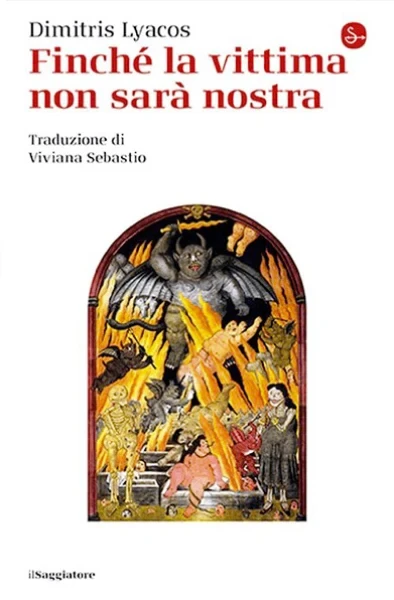
He told me that day in May 2025, at the Turin Book Fair, during the book signing: “this is not a normal book; don’t read it all in one go, but one chapter at a time, sporadically.” Needless to say, I didn’t follow his advice. I couldn’t have expected a linear book from someone like Dimitris Lyacos, the most famous contemporary Greek author, increasingly mentioned among the possible Nobel candidates, who during the Turin event delivered one of the most rollicking presentations I have ever witnessed.Original in Italian
This Finché la vittima non sarà nostra by the Greek writer Dimitris Lyacos is a book of extreme difficulty. Constantly poised between myth and allegory, deliberately cryptic and disorienting, it resists placement within any precise category. It is certainly not a novel, nor a collection of short stories, since there is no plot or narrative arc. Nor is it a philosophical treatise, lacking an argumentative path, a triptych of thesis–antithesis–synthesis, or even simple speculation. It is, however, an illustration—through small tableaux—of the many facets of violence, both human and, more broadly, permeating the entire world. It is a reflection on how humanity has attempted to take control of this violence in order to tame it, on its successes and its failures. The book is structured in short chapters, each marked by a letter of the alphabet. In each one there is a different scene, described through suggestion and without any literal foothold to guide the reader, who in fact enters them like a traveler stepping into a dark cave, forced to grope their way forward. In more than one interview, Lyacos has stated that the work was deliberately released without any subtext, without points of reference, without contexts. The result is a cryptic message, not universally accessible. If literature is (also) communication, Lyacos deliberately undermines this aspect, while at the same time insisting that there is indeed a content: his reflection on violence as an archetype. This raises the question of how these two things can be held together, given that communication—even literary communication—presupposes a sender, a receiver, and a medium capable of connecting the two shores. In this case, the medium is a fragile bridge on which the reader feels unsteady. Unless one chooses to abandon oneself to the mere sound of words, to the visceral emotion evoked by the stream of consciousness, what remains of the reading experience is a sense of incompleteness and even frustration.Original in italian
The Primordial Storm Klee’s Angelus Novus is, for Benjamin, the figure of history advancing inexorably, driven by the primordial storm, and inevitably destroying everything with wings spread wide. Its face looks backward, capable only of contemplating the ruins it leaves behind. Finché la vittima non sarà nostra seems to evoke precisely this figure. It only seems so, however, because Benjamin’s Angel of History is a metaphor, whereas Lyacos’s new book—except for a single aspect, to which we will need to return—is not.Original in Italian